Charles the Fat
The emperor who reunited Charlemagne’s empire one last time, disgraced during the Viking siege of Paris.
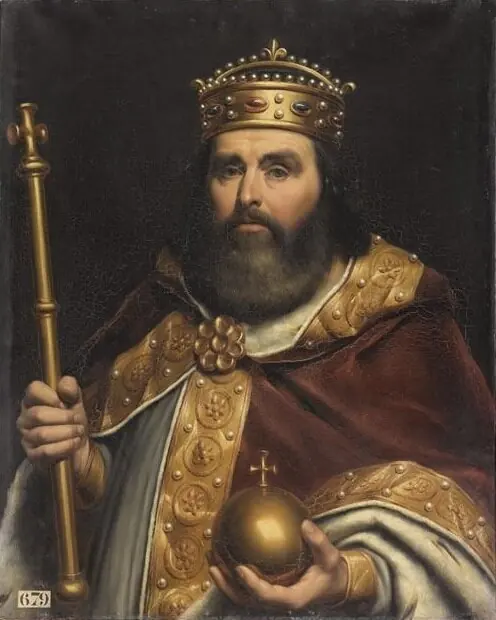
Public domain — Wikimedia Commons
1In brief
A great-grandson of Charlemagne, Charles the Fat was king of Alemannia and Italy, emperor, then king of East Francia. In 884 the great lords of West Francia called on him in turn: he then reigned over almost the whole former empire. But his conduct during the siege of Paris discredited him, and he was deposed in 887.
2Life
The son of Louis the German, Charles inherited part of his father’s kingdom, then, through a series of deaths in the family, almost all the Carolingian kingdoms. Crowned emperor in Rome in 881, he became king of West Francia in 884, on the death of Carloman II, because the heir, Charles the Simple, was too young.
In 885 a huge Viking fleet besieged Paris. Count Odo and Bishop Gozlin defended the city for months. When the emperor finally arrived with his army in 886, he did not give battle: he paid the Vikings and allowed them to go and plunder Burgundy. Ill, perhaps epileptic, he was abandoned by the great lords and deposed by his nephew Arnulf in November 887. He died a few weeks later.
3Reign
- 876King of Alemannia
- 881Crowned emperor in Rome
- 884King of West Francia: the empire is reunited
- 885-886Viking siege of Paris
- 887Deposed by his nephew Arnulf
- 888Dies at Neidingen
4Legacy
With the fall of Charles the Fat, the unity of the Carolingian empire vanished for ever. Each kingdom chose its own king: in West Francia the great lords elected the hero of the siege of Paris, Count Odo.
5Did you know?
His nickname, “the Fat”, only appears long after his death.
The siege of Paris was told in Latin verse by a monk who witnessed it, Abbo of Saint-Germain-des-Prés.