Merovingians
The first dynasty of Frankish kings, from Clovis to the “do-nothing kings”, for almost three centuries.
The Merovingians take their name from Merovech, Clovis’s half-legendary ancestor. Coming from northern Gaul, these Frankish chiefs became masters of almost the whole country after the fall of the Western Roman Empire. Clovis, king from 481 to 511, defeated his rivals, was baptised and made Paris his capital.
Among the Franks, the kingdom was divided between the king’s sons like an inheritance. Brothers often became rivals: family wars, murders and reunifications followed one another, like the terrible rivalry between Queens Brunhild and Fredegund. Dagobert I was the last great king of the family.
After him, the kings, often very young, left real power to the “mayors of the palace”. In the 19th century they were called the “do-nothing kings”, an exaggerated picture. In 751 Pepin the Short, mayor of the palace, shut Childeric III away in a monastery and took the crown.
The Merovingians are the very first family of kings. Their most famous leader, Clovis, united the Franks more than 1,500 years ago. When a king died, his sons shared out the kingdom… and often quarrelled!
- The kingdom is shared between the king’s sons
- The kings wear long hair as a sign of their rank
- Clovis’s baptism allies the Frankish kings with the Church
- The mayors of the palace end up ruling instead of the kings
The family tree
Click a name to open the profile. Queens appear under their husbands; grey boxes are family members who did not reign.
The rulers
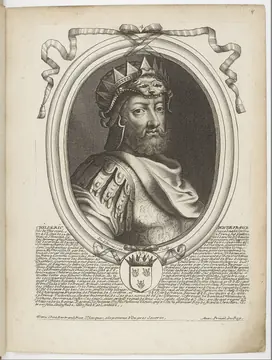 c. 457–481
Childeric I
Childeric I was the chief of the Salian Franks settled around Tournai, in present-day Belgium. An ally of the last Roman generals in Gaul, he fought alongside them against the Visigoths and the Saxons. He is the first Frankish king whose grave is known.
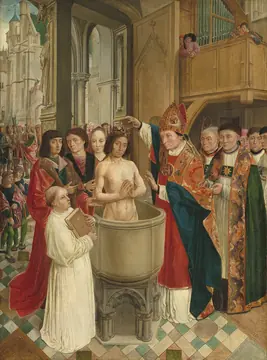 481–511
Clovis I
Clovis became king of the Salian Franks at about fifteen. In thirty years of wars he brought almost all of Gaul under his rule. His Catholic baptism at Reims won him the support of the bishops and the Gallo-Roman population. He is often presented as the first king of France.
 511–558, 558–561
Chlothar I
the OldWhen Clovis died, Chlothar received the kingdom of Soissons. For almost fifty years he made war on the Thuringians, the Burgundians and sometimes his own brothers and nephews. Outliving his whole family, he reigned alone over the Franks from 558 until his death in 561.
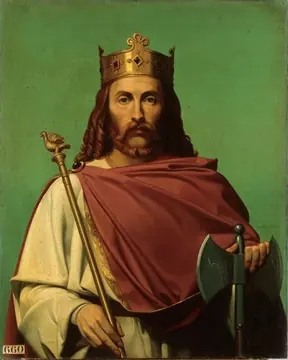 561–584
Chilperic I
The son of Chlothar I, Chilperic received the north-western part of the kingdom, the future Neustria, in 561. His reign was dominated by a merciless war against his brother Sigebert and Sigebert’s wife, Brunhild. He was murdered in 584.
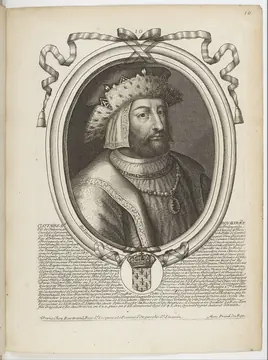 584–613, 613–629
Chlothar II
the GreatThe son of Chilperic and Fredegund, Chlothar II became king of Neustria in 584 as a baby, under his mother’s protection. After years of war against Brunhild’s descendants, he reunited the whole kingdom in 613 and ruled it until his death in 629.
 623–629, 629–639
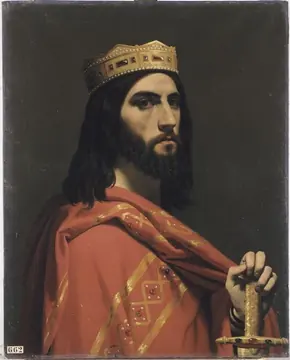
Dagobert I
good King DagobertThe son of Chlothar II, Dagobert ruled Austrasia from 623, then the whole Frankish kingdom from 629 to 639. Surrounded by advisers such as Saint Eligius, he governed a powerful and prosperous kingdom from Paris. He was the first king buried at Saint-Denis.
 639–657
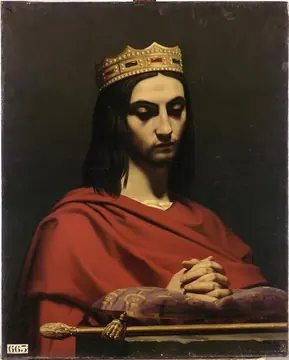
Clovis II
The son of Dagobert I, Clovis II became king of Neustria and Burgundy at about five, in 639. Government was in the hands of his mother Nanthild, then of the mayors of the palace. He married Bathild, a former Anglo-Saxon slave, and died at about twenty-three.
 743–751
Childeric III
the last MerovingianChilderic III was placed on the throne in 743 by the mayors of the palace Carloman and Pepin, sons of Charles Martel, after several years without a king. He had no real power. In 751 Pepin had him deposed, his hair cut and shut away in a monastery, and took his place.
Queens and regents
 c. 493–511
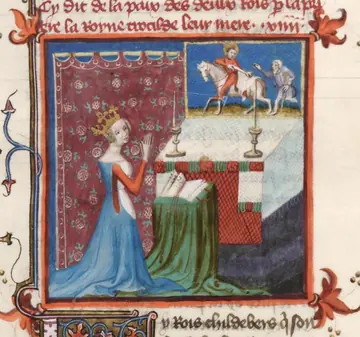
Clotilde
Saint ClotildeA Burgundian princess and a Catholic Christian, Clotilde married Clovis around 493. According to tradition, she played a big part in his conversion. Widowed in 511, she withdrew to Tours, near the tomb of Saint Martin, where she died in 545. She is honoured as a saint.
 567–575, 575–613
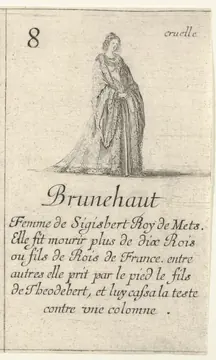
Brunhilda
The daughter of the Visigothic king of Spain, Brunhild married Sigebert I, king of Austrasia, in 567. After her husband’s murder she ruled for her son, her grandsons and her great-grandson. Her rivalry with Fredegund bloodied the Frankish kingdom for decades.
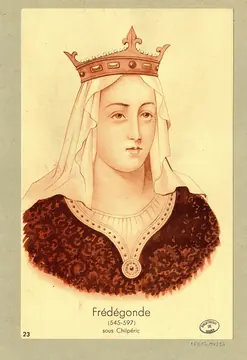 c. 568–584, 584–597
Fredegund
First a servant of Chilperic’s first wife, Fredegund became his companion and then his queen. The chronicles blame her for many murders, including that of King Sigebert. Widowed in 584, she ruled skilfully in the name of her son Chlothar II until her death in 597.
 c. 648–657, 657–c. 664
Balthild
Saint BalthildKidnapped in England and sold as a slave, Bathild entered the service of the mayor of the palace Erchinoald, then married King Clovis II around 648. Widowed in 657, she ruled in the name of her son Chlothar III, then withdrew to the abbey of Chelles, which she had founded.