Valois
From the Hundred Years’ War to the Wars of Religion by way of the Renaissance: the family of Charles V, Louis XI and Francis I.
The Valois, cousins of the last direct Capetians, came to the throne in 1328. Their beginnings were terrible: defeats by the English at Crécy and Poitiers, the Black Death, a king taken prisoner, then the madness of Charles VI. With Joan of Arc, Charles VII regained the upper hand and the Hundred Years’ War ended in 1453.
Louis XI strengthened royal authority; his successors launched the Italian Wars. Two cousin branches followed: the Valois-Orléans with Louis XII, then the Valois-Angoulême with Francis I, king of the Renaissance, of the Loire châteaux and of Leonardo da Vinci.
The second half of the 16th century was torn apart by the Wars of Religion between Catholics and Protestants. The three sons of Henry II and Catherine de’ Medici reigned in turn, leaving no sons. Henry III was assassinated in 1589: the crown passed to his distant cousin, Henry of Bourbon.
The Valois reigned during the Hundred Years’ War against the English, then during the Renaissance, when the beautiful Loire châteaux were built. Francis I, Leonardo da Vinci’s friend, is the most famous of them.
- The Hundred Years’ War against England
- The kingdom grows: Burgundy, Provence, Brittany
- The Renaissance and the Loire châteaux
- The Wars of Religion tear the country apart
The family tree
Click a name to open the profile. Queens appear under their husbands; grey boxes are family members who did not reign.
The rulers
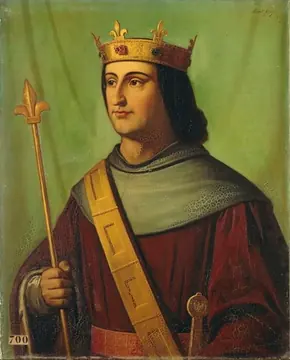 1328–1350
Philip VI
of ValoisA nephew of Philip the Fair, Philip of Valois was chosen as king in 1328, on the death of his cousin Charles IV, in preference to King Edward III of England. His reign saw the start of the Hundred Years’ War, the defeat at Crécy, the loss of Calais and the Black Death. Yet he enlarged the kingdom with the Dauphiné and Montpellier.
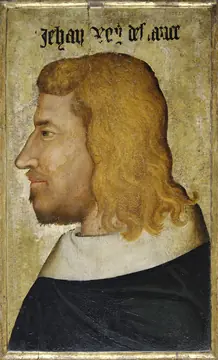 1350–1364
John II
the GoodThe son of Philip VI, John II the Good reigned from 1350 to 1364, in the thick of the Hundred Years’ War. Defeated and captured by the English at Poitiers in 1356, he spent four years as a prisoner in London. To pay his enormous ransom, a new coin was created: the franc. He died in London in 1364.
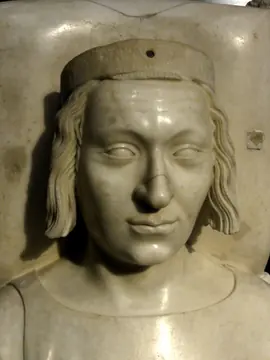 1364–1380
Charles V
the WiseThe first Dauphin of France, Charles V first governed during his father’s captivity, amid revolts. King from 1364 to 1380, he restored the kingdom: with Constable Du Guesclin he took back most of the English conquests without fighting a great battle. A learned man, he gathered a great library at the Louvre.
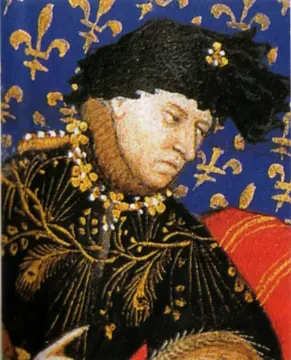 1380–1422
Charles VI
the Beloved or the MadKing at eleven, Charles VI reigned from 1380 to 1422. In 1392 he was struck by a fit of madness, the first of a long series. During his absences his uncles and brother fought over power: the civil war between Armagnacs and Burgundians. The English took advantage and triumphed at Agincourt in 1415.
 1422–1461
Charles VII
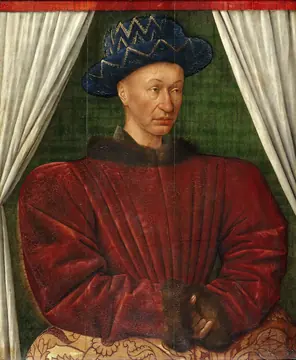
the VictoriousDisinherited by the Treaty of Troyes, the Dauphin Charles proclaimed himself king in 1422 but controlled only the lands south of the Loire. In 1429 Joan of Arc relieved Orléans and led him to Reims to be crowned. He then reconquered Paris, Normandy and Guyenne: in 1453 the Hundred Years’ War came to an end.
 1461–1483
Louis XI
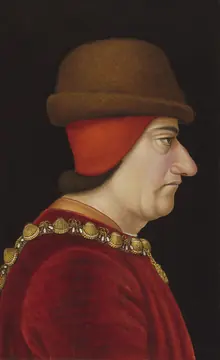
the PrudentThe rebellious son of Charles VII, Louis XI reigned from 1461 to 1483. Suspicious, hard-working and cunning, he preferred diplomacy and money to battles. He got the better of the coalition of great lords and above all of the duke of Burgundy, Charles the Bold. At his death the kingdom had gained Burgundy, Picardy, Anjou, Maine and Provence.
 1483–1498
Charles VIII
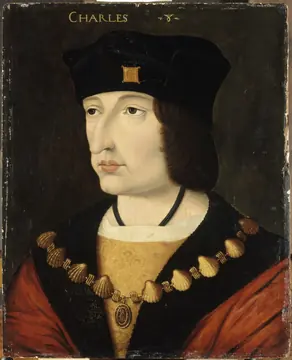
the AffableThe son of Louis XI, Charles VIII became king at thirteen, under the guardianship of his sister Anne of Beaujeu. In 1491 he married Anne of Brittany. In 1494 he launched the Italian Wars and entered Naples, but soon had to leave. He died in 1498 at Amboise after hitting his head on a doorway.
 1498–1515
Louis XII
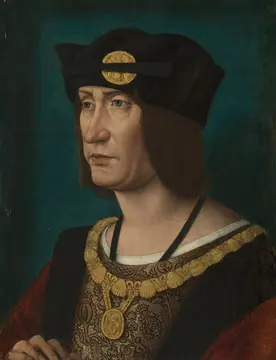
the Father of the PeopleCharles VIII’s cousin, Louis of Orléans became king in 1498 as Louis XII. He had his first marriage annulled to marry Anne of Brittany, conquered the duchy of Milan and then lost it. In France he governed with moderation and lowered taxes: in 1506 the Estates General gave him the title “Father of the People”.
 1515–1547
Francis I
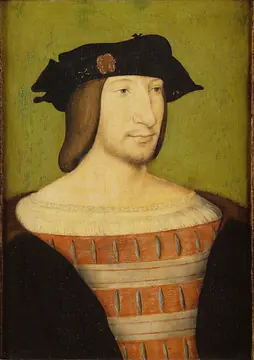
the Knight KingLouis XII’s cousin and son-in-law, Francis I reigned from 1515 to 1547. A dashing knight, he triumphed at Marignano in 1515, but was taken prisoner at Pavia in 1525 by his great rival, Emperor Charles V. A patron of the arts and letters, he brought Leonardo da Vinci to France, built Chambord and imposed French in official acts.
 1547–1559
Henry II
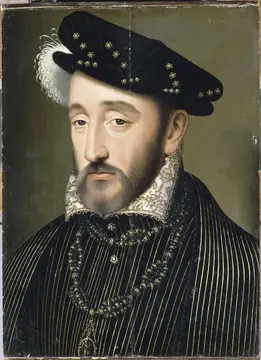
The son of Francis I, Henry II reigned from 1547 to 1559. He took Metz, Toul and Verdun from the Empire in 1552 and retook Calais from the English in 1558. In 1559 the Peace of Cateau-Cambrésis ended the Italian Wars. A few weeks later he was fatally wounded in the eye during a tournament.
 1559–1560
Francis II
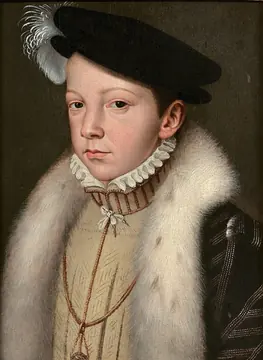
The eldest son of Henry II and Catherine de’ Medici, Francis II became king in July 1559 at fifteen. Married to Mary, Queen of Scots, he let his wife’s uncles, the Guises, govern; they harshly repressed the Protestants. He died in December 1560, aged sixteen.
 1560–1574
Charles IX
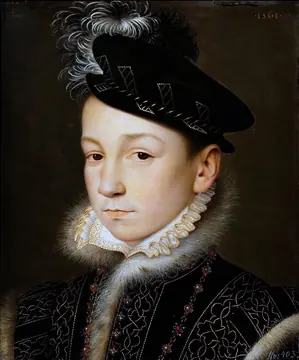
Henry II’s second son, Charles IX became king in 1560 at ten, under the regency of his mother Catherine de’ Medici. His reign was marked by the first Wars of Religion and, in 1572, by the St Bartholomew’s Day massacre. In poor health, he died in 1574 aged twenty-three.
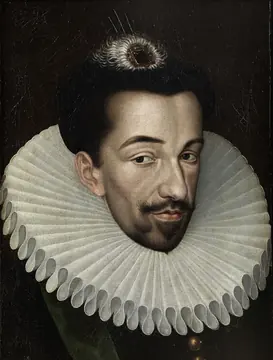 1574–1589, 1573–1575
Henry III
Henry II’s third son, Henry was elected king of Poland in 1573, then became king of France in 1574. He reigned at the height of the Wars of Religion, facing the powerful Catholic League of the duke of Guise. Driven out of Paris, he had Guise assassinated in 1588, allied with Henry of Navarre and was stabbed to death by a monk in 1589.
Queens and regents
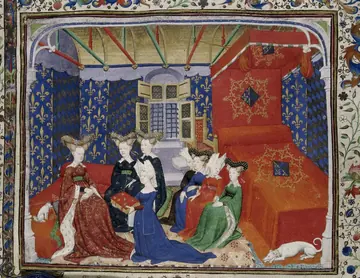 1385–1422
Isabeau of Bavaria
A Bavarian princess, Isabeau married Charles VI in 1385. When the king sank into madness, she was called upon to preside over the council and arbitrate between rival princes. Allied with the duke of Burgundy, she approved in 1420 the Treaty of Troyes, which disinherited her son. She died in Paris in 1435.
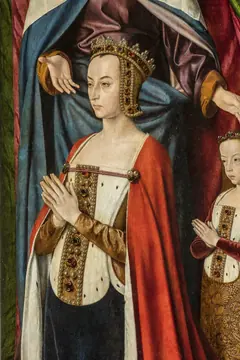 1483–1491
Anne of Beaujeu
Anne of FranceLouis XI’s eldest daughter, Anne of France, Lady of Beaujeu, was in practice regent from 1483 to 1491 for her brother Charles VIII, with her husband Peter of Bourbon. Skilful and firm, she defeated the revolt of the great lords led by the future Louis XII and married her brother to the heiress of Brittany.
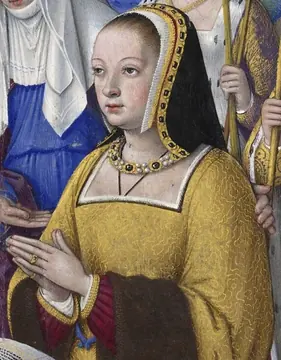 1491–1498, 1488–1514, 1499–1514
Anne of Brittany
the duchess in clogsHeiress to the duchy of Brittany at eleven, Anne had to marry King Charles VIII in 1491, whose army had invaded her duchy. Widowed in 1498, she married his successor, Louis XII. Twice queen of France, she defended Brittany’s autonomy and kept a brilliant court. She died in 1514.
 1515–1524, 1514–1524
Claude of France
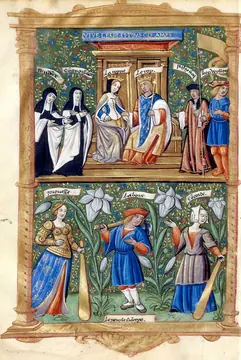
Queen ClaudeThe eldest daughter of Louis XII and Anne of Brittany, Claude inherited the duchy of Brittany on her mother’s death in 1514 and that same year married her cousin Francis of Angoulême, who became king in 1515. Quiet and often pregnant, she gave the king seven children in nine years and died at twenty-four.
 1547–1559, 1560–1563
Catherine de’ Medici
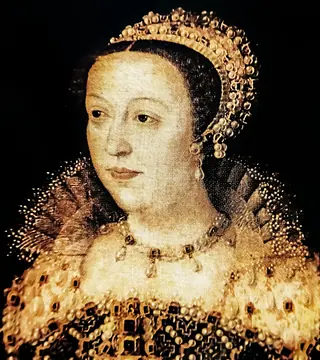
Heiress of the Medici of Florence, Catherine married the future Henry II in 1533. Widowed in 1559, she governed in the name of her sons Francis II, Charles IX and Henry III. She first sought to reconcile Catholics and Protestants, but her name remains linked to the St Bartholomew’s Day massacre. She died in 1589.
 1559–1560, 1542–1567
Mary, Queen of Scots
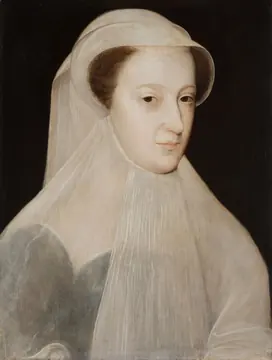
The daughter of King James V of Scotland, Mary became queen of Scots a few days after her birth. Brought up in France, she married the future Francis II and was queen of France in 1559-1560. Widowed at eighteen, she returned to Scotland, where her reign turned to tragedy. Taking refuge in England, she was imprisoned there for nineteen years, then executed in 1587.