Clovis I
The king who united the Franks, conquered Gaul, was baptised and made Paris his capital.
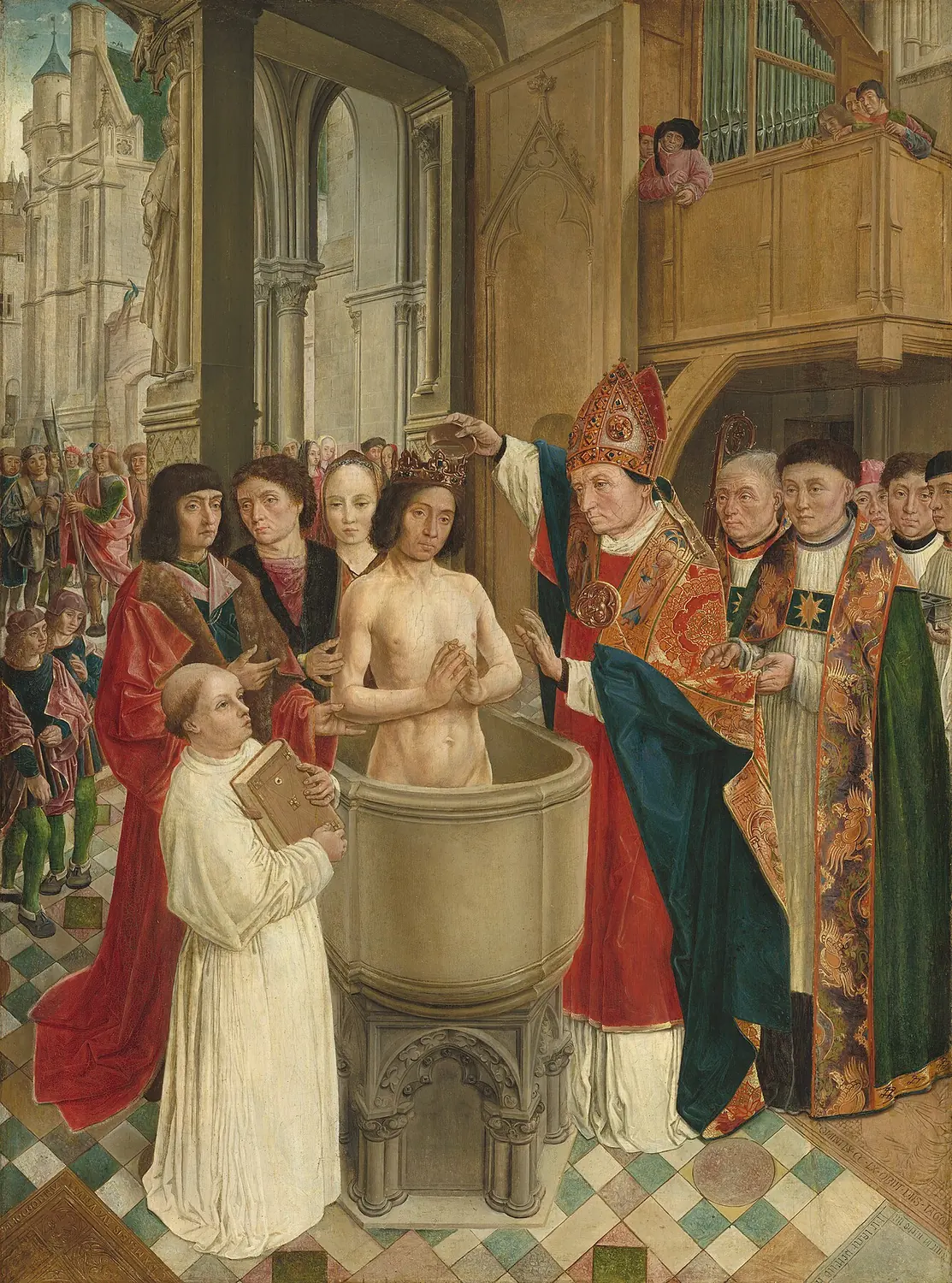
CC0 — Wikimedia Commons
1In brief
Clovis became king of the Salian Franks at about fifteen. In thirty years of wars he brought almost all of Gaul under his rule. His Catholic baptism at Reims won him the support of the bishops and the Gallo-Roman population. He is often presented as the first king of France.
2Life
The son of Childeric, Clovis inherited a small kingdom around Tournai in 481. In 486 he defeated Syagrius, the last Roman ruler of northern Gaul, at Soissons. He then married Clotilde, a Catholic Burgundian princess, and subdued the Alamanni, then the other Frankish chiefs, often his own relatives, whom he had killed.
Around 496-499 he was baptised at Reims by Bishop Remigius, with thousands of his warriors. Unlike the other barbarian kings, who were Arian Christians, he chose the Catholic faith of the Gallo-Romans. In 507 he defeated the Visigoths at Vouillé and pushed them back towards Spain. He made Paris his residence, held a council of bishops at Orléans and had the law of the Franks, the Salic law, written down. He died in 511; his kingdom was divided between his four sons.
3Reign
- 481Becomes king of the Salian Franks
- 486Victory at Soissons over Syagrius
- c. 496Victory over the Alamanni, at Tolbiac according to tradition
- c. 496-499Baptised at Reims by Bishop Remigius
- 507Victory at Vouillé over the Visigoths
- 511Council of Orléans; dies in Paris
4Legacy
Clovis gave the Franks a great kingdom, a capital, Paris, and the alliance with the Catholic Church that became one of the foundations of the monarchy. His baptism at Reims explains why kings were later crowned there. His name gave rise to the name Louis (Clodovicus, Ludovicus), borne by eighteen kings.
5Did you know?
Clovis and Louis are the same name: in Latin Chlodovechus, which became Ludovicus, then Louis.
He was buried in the Church of the Holy Apostles, which he had founded in Paris on the Montagne Sainte-Geneviève, near today’s Panthéon.
The story of the Soissons vase, in which Clovis splits the skull of a soldier who had broken a vase claimed by a bishop, comes from Gregory of Tours, writing almost a century later. It is probably embellished, like Remigius’s famous words at the baptism: “Bow your head, proud Sicambrian!”
6Family
 Childeric IFather
 ClotildeWife
 Chlothar IChild