Dagobert I
good King Dagobert
The last great Merovingian king, protector of the abbey of Saint-Denis, made famous by a mocking song.
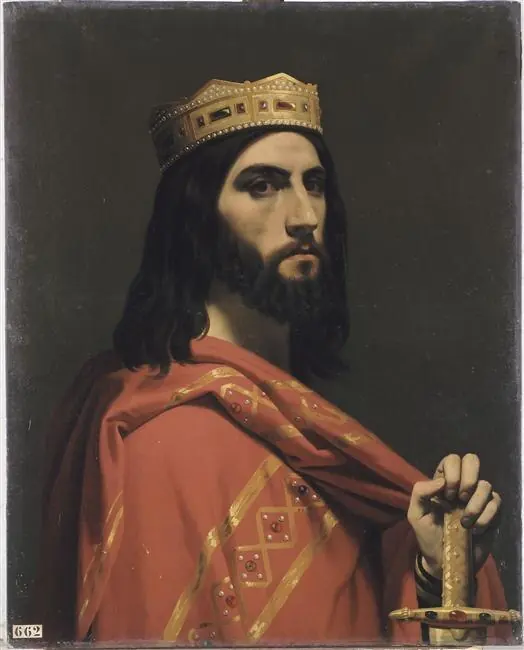
Public domain — Wikimedia Commons
1In brief
The son of Chlothar II, Dagobert ruled Austrasia from 623, then the whole Frankish kingdom from 629 to 639. Surrounded by advisers such as Saint Eligius, he governed a powerful and prosperous kingdom from Paris. He was the first king buried at Saint-Denis.
2Life
Placed young on the throne of Austrasia by his father, under the guardianship of Bishop Arnulf of Metz and the mayor of the palace Pepin of Landen, Dagobert became sole king in 629. He travelled throughout the kingdom to dispense justice, led campaigns against the Gascons, the Bretons and the Slavs, and made his authority felt to the edges of the kingdom.
He relied on learned advisers: Eligius, a goldsmith who became the king’s treasurer and moneyer, then bishop of Noyon, and Audoin, later bishop of Rouen. A great protector of the abbey of Saint-Denis, he showered it with gifts and was buried there when he died in 639. After him the power of the Merovingian kings steadily weakened.
3Reign
- 623King of Austrasia
- 629Sole king of all the Franks; settles in Paris
- c. 631Campaign against Samo’s Slavs
- 632Gives Austrasia to his son Sigebert III
- 639Dies; first king buried at Saint-Denis
4Legacy
Dagobert was the last Merovingian to really govern. His tomb, remade in the 13th century, is still in the basilica of Saint-Denis. His “throne”, a bronze seat kept at the Bibliothèque nationale de France, was attributed to him by tradition.
5Did you know?
The French nursery song “Good King Dagobert put his breeches on back to front” only dates from the 18th century; it probably made fun of the king of the time through this distant ancestor.
Saint Eligius, his adviser, is the patron saint of goldsmiths and blacksmiths.
In the song, Saint Eligius keeps correcting the absent-minded king. Nothing suggests Dagobert was clumsy: on the contrary, he was an active and respected king.
 Chlothar II
 Clovis II