Hugh Capet
Elected king in 987, he founded the Capetian dynasty, whose descendants reigned until 1848.
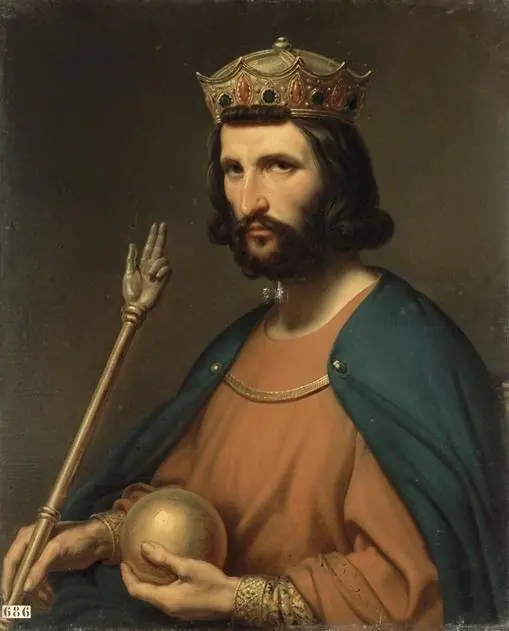
Public domain — Wikimedia Commons
1In brief
The son of Hugh the Great, duke of the Franks, Hugh was elected king at Senlis in 987, after the death of Louis V. His real power was limited to a few regions around Paris and Orléans, but he took a crucial decision: to have his son Robert crowned during his own lifetime to secure his succession. He died in 996.
2Life
Heir to the powerful Robertian family, Hugh was duke of the Franks and lay abbot of several great abbeys. When Louis V died, Archbishop Adalbero of Reims pleaded for him before the great lords: the crown, he said, is not gained by inheritance but by nobility and wisdom. Hugh was elected, then crowned in July 987.
As early as December 987 he had his son Robert crowned at Orléans. He had to fight the Carolingian claimant Charles of Lorraine, who seized Laon and Reims. In 991 the bishop of Laon handed Charles over by treachery; he died in captivity. Hugh died in 996 and was buried at Saint-Denis.
3Reign
- 987Elected king at Senlis, then crowned
- 987Has his son Robert crowned at Orléans
- 988Charles of Lorraine seizes Laon
- 991Capture of Charles of Lorraine
- 996Dies
4Legacy
Hugh Capet is the ancestor of every king of France down to Charles X, and of Louis Philippe: the direct Capetians, the Valois and the Bourbons are all his descendants in the male line. The name “Capetians” comes from him.
5Did you know?
His nickname, “Capet”, probably comes from the cape (chape) he wore as lay abbot of Saint-Martin of Tours; it only appears after his death.
In 1792 the revolutionaries called Louis XVI “Louis Capet”, after this distant ancestor.
Hugh is said to have asked a rebellious count: “Who made you a count?”, and the count to have replied: “Who made you king?” The story, reported by a later chronicler, is not reliable.
 Robert II