Charlemagne
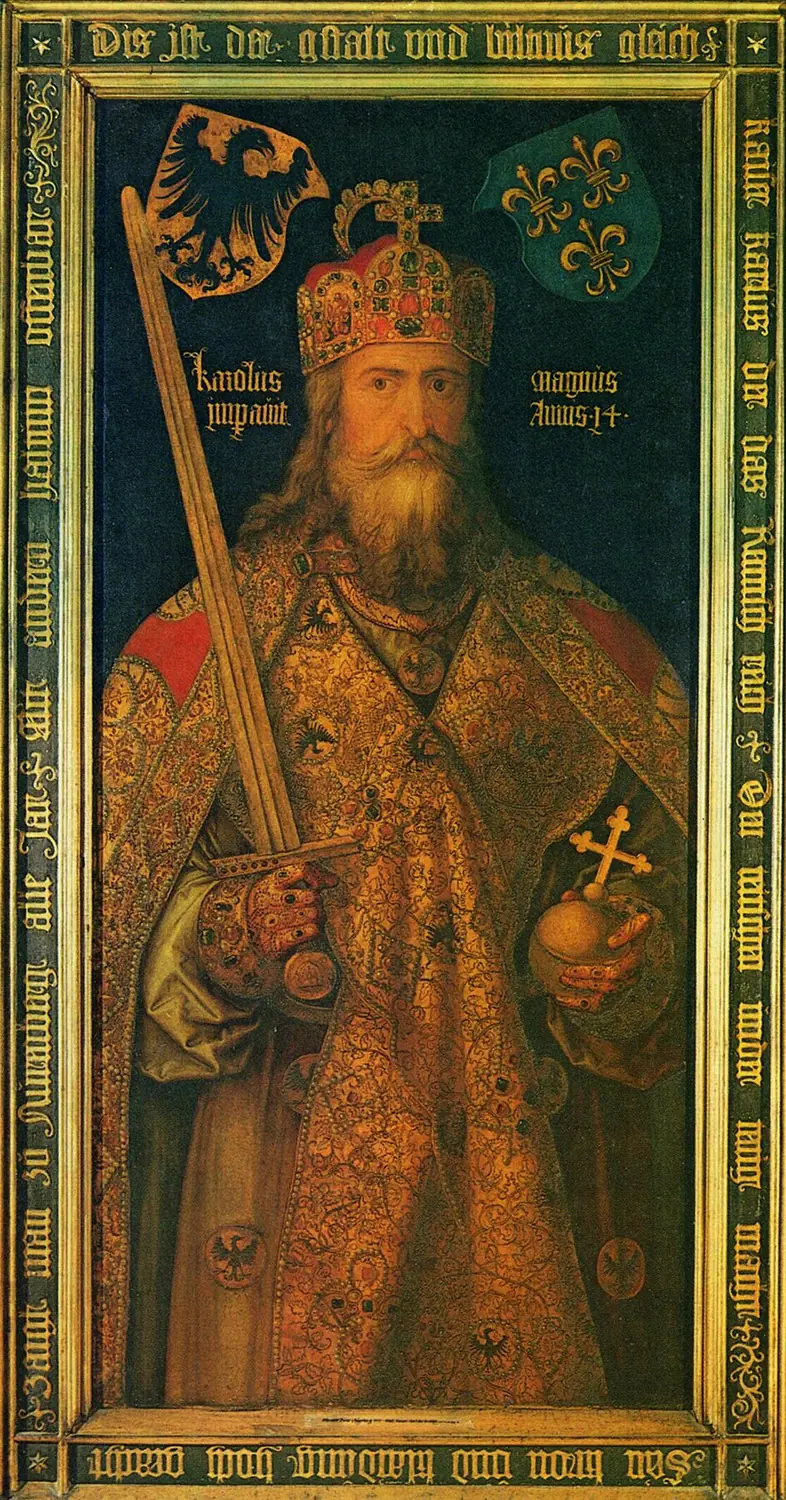
Charles the Great
The king of the Franks who became emperor of the West in 800, conqueror, lawgiver and patron of schools.
Public domain — Wikimedia Commons
1In brief
The son of Pepin the Short, Charlemagne reigned for forty-six years. He conquered Lombardy, Saxony and Bavaria, brought much of western Europe under his rule and was crowned emperor in Rome in 800. He encouraged learning and teaching: this is the “Carolingian renaissance”.
2Life
King in 768 with his brother Carloman, sole king in 771, Charlemagne spent almost every summer on campaign. He became king of the Lombards in 774, subdued the Saxons after thirty years of very harsh wars, forcing them to convert, and broke the power of the Avars. In 778, on his way back from Spain, his rearguard was massacred by Basques at Roncevaux: the Song of Roland would turn it into an epic.
On Christmas Day 800, in Rome, Pope Leo III crowned him emperor. From his palace at Aachen he governed with the help of counts and “missi dominici”, envoys who inspected the provinces in pairs. He gathered scholars such as Alcuin, had ancient texts copied in a new, clear script, and asked churches and monasteries to open schools. He died at Aachen in 814.
3Reign
- 768King of the Franks with his brother Carloman
- 774King of the Lombards
- 778Defeat at Roncevaux
- 772-804Wars against the Saxons
- 800Crowned emperor in Rome on 25 December
- 814Dies at Aachen
4Legacy
Charlemagne is claimed by both France and Germany and is sometimes called the “father of Europe”. His empire did not survive his grandsons, but the script he encouraged, Carolingian minuscule, is the ancestor of the lower-case letters we use today.
5Did you know?
According to his biographer Einhard, he could read but found writing hard: he kept tablets under his pillow to practise at night.
The caliph of Baghdad, Harun al-Rashid, gave him an elephant named Abul-Abbas, which reached Aachen in 802.
Charlemagne did not “invent school”, as a French song claims: schools existed before him. But he really did ask for more to be opened. As for his “flowing white beard”, it comes from the Song of Roland; portraits from his lifetime show him with a moustache.
6Family
 Pepin the ShortFather
 Bertrada of LaonMother
 Louis the PiousChild