John II
the Good
The knightly king captured at Poitiers, whose ransom gave birth to the franc.
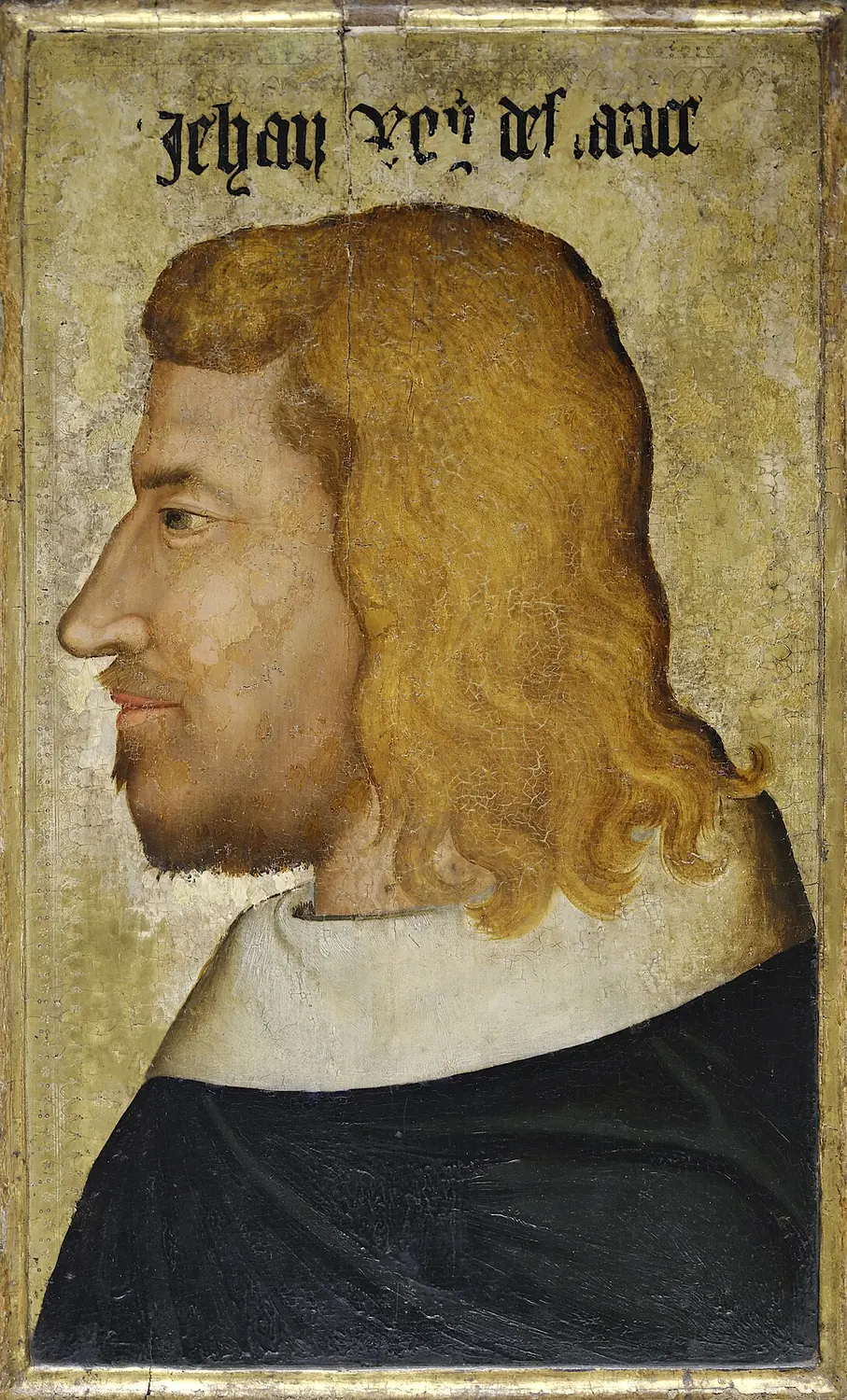
Public domain — Wikimedia Commons
1In brief
The son of Philip VI, John II the Good reigned from 1350 to 1364, in the thick of the Hundred Years’ War. Defeated and captured by the English at Poitiers in 1356, he spent four years as a prisoner in London. To pay his enormous ransom, a new coin was created: the franc. He died in London in 1364.
2Life
A king in love with chivalry, John founded the Order of the Star in 1351. He clashed with his son-in-law and cousin, Charles the Bad, king of Navarre, who plotted with the English. On 19 September 1356, near Poitiers, his army was beaten by the Black Prince, Edward III’s son. John fought to the end, protected by his young son Philip, then surrendered.
During his captivity his eldest son, the Dauphin Charles, faced Étienne Marcel’s revolt in Paris and, in the countryside, the Jacquerie. In 1360 the Treaty of Brétigny freed the king in exchange for a ransom of three million écus and a third of the kingdom. When one of his sons, left as a hostage, escaped, John went back to London of his own accord, out of honour. He died there in 1364.
3Reign
- 1350King; crowned at Reims
- 1351Founds the Order of the Star
- 1356Defeated and captured at Poitiers
- 1360Treaty of Brétigny; the franc is created
- 1363Gives Burgundy to his son Philip
- 1364Returns to London, where he dies
4Legacy
The franc, created in 1360 to pay his ransom, was France’s currency until 2002. By giving Burgundy to his son Philip the Bold, John II also created the powerful house of the dukes of Burgundy.
5Did you know?
His portrait, kept in the Louvre, is the oldest known independent painted portrait in France.
At Poitiers his fourteen-year-old son Philip shouted to him: “Father, guard your right! Father, guard your left!”
6Family
 Philip VIFather
 Charles VChild