Louis Philippe I
the Citizen King
The “King of the French” of the July Monarchy: a king in middle-class clothes, overthrown by the revolution of February 1848.
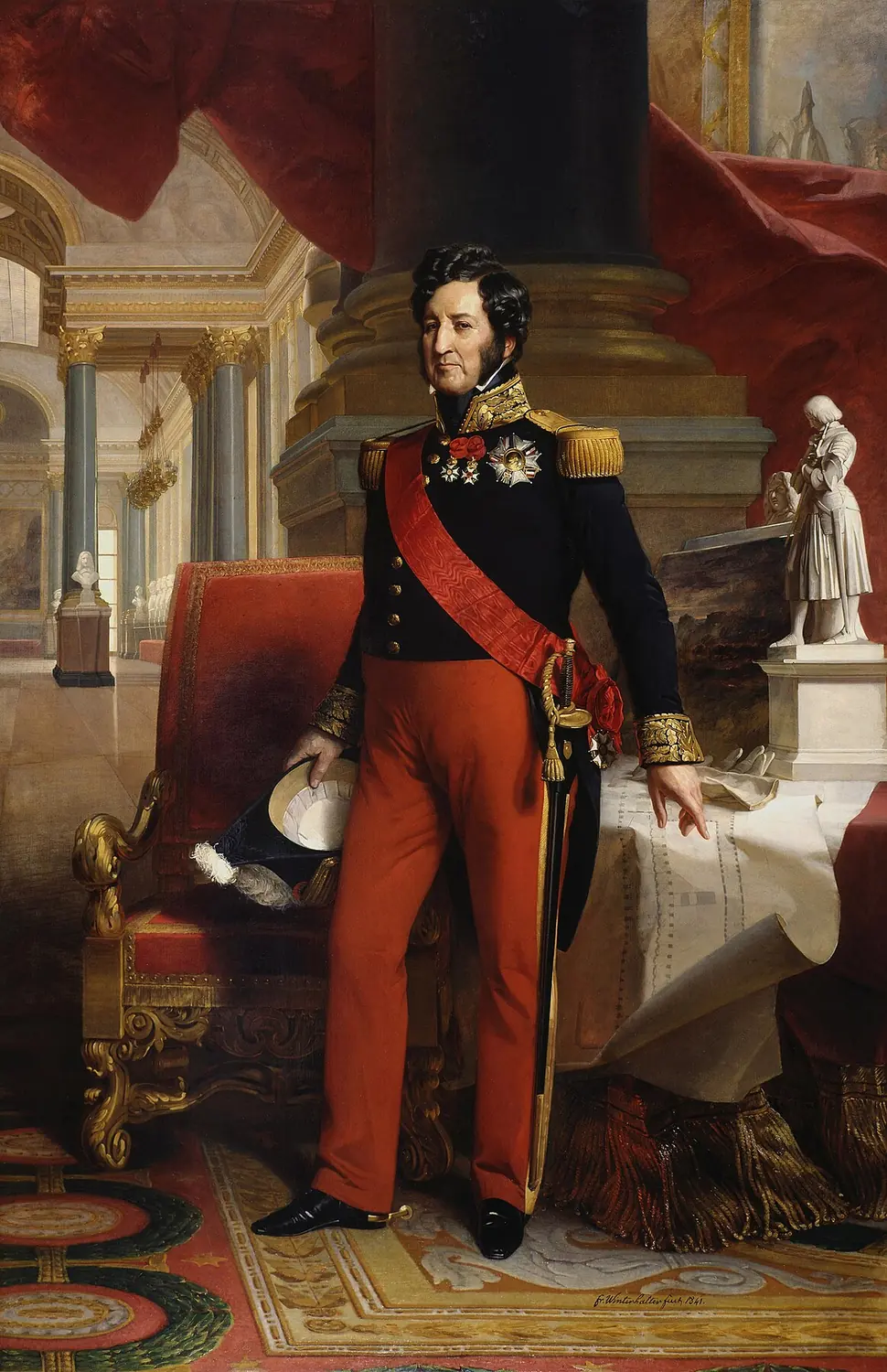
Public domain — Wikimedia Commons
1In brief
The son of the Duke of Orléans known as Philippe Égalité, Louis Philippe fought in the armies of the Revolution before a long exile. Brought to power by the July Revolution of 1830, he took the title of King of the French and reigned alongside Parliament. After eighteen years, a new revolution drove him out in February 1848; he died in England in 1850.
2Life
Born at the Palais-Royal in 1773, a descendant of Louis XIV’s brother, Louis Philippe of Orléans was brought up along modern lines by the writer Madame de Genlis. As a young officer he fought for the Revolution at Valmy and Jemappes in 1792. But his father, who had voted for Louis XVI’s death, was guillotined in 1793, and he himself had to flee. He taught for a while in a Swiss school under a false name, travelled as far as Lapland and the United States, then married Maria Amalia of Naples and Sicily in 1809. They had ten children.
In 1830 the liberal deputies offered him the crown after Charles X’s fall. He swore to respect the revised Charter and adopted the tricolour flag. Under his reign industry and railways grew, primary schooling spread thanks to the Guizot Law of 1833, and the Palace of Versailles became a museum of French history. But the vote remained reserved for the wealthiest. He survived several assassination attempts and countless caricatures. In February 1848 Paris rose up: he abdicated and left for England, where he died at Claremont in 1850.
3Reign
- 1792Fights at Valmy and Jemappes
- 1793Start of his exile
- 1809Marries Maria Amalia
- 1830King of the French
- 1833Guizot Law on primary schools
- 1837Versailles museum opens
- 1840Napoleon’s remains brought back
- 1848February Revolution; abdication
4Legacy
Louis Philippe was the last king of France. His reign, the July Monarchy, was a time of relative peace and economic growth. He rests with Maria Amalia in the Royal Chapel of Dreux, the burial place of the Orléans family.
5Did you know?
Cartoonists drew his head in the shape of a pear; the drawing became so famous that people scrawled it on the walls of Paris.
He had Napoleon’s body brought back from Saint Helena; it was received at the Invalides in December 1840.
6Family
 Maria Amalia of Naples and SicilyWife