Napoleon I
the Little Corporal
The general who became emperor: he reorganised France, conquered much of Europe, then was defeated at Waterloo.
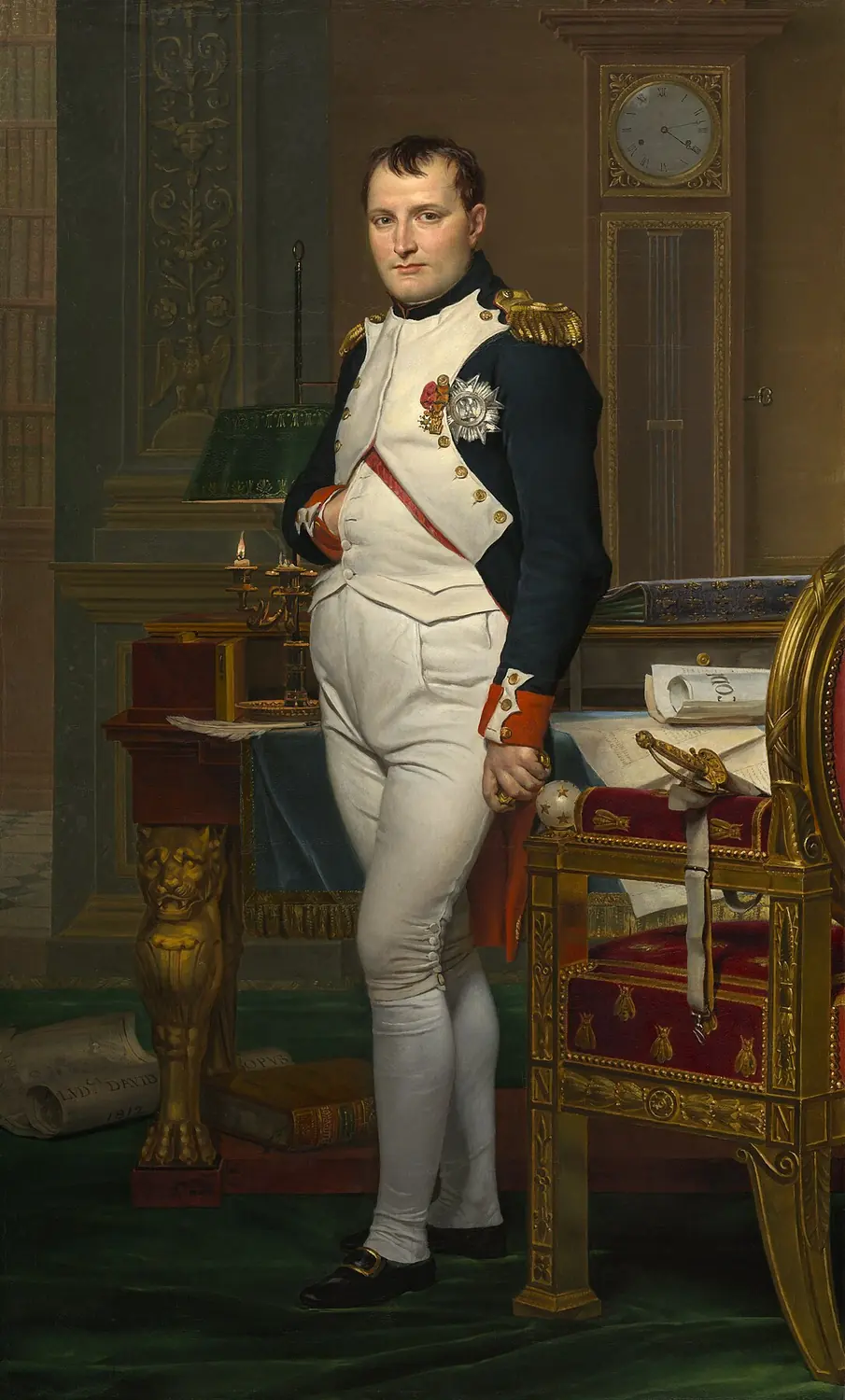
Public domain — Wikimedia Commons
1In brief
A Corsican officer trained in the king’s military schools, Napoleon Bonaparte made his name during the Revolution with his victories in Italy. He seized power in a coup in 1799, became First Consul and then Emperor of the French in 1804. He created the Civil Code, the prefects and the lycées, and dominated Europe until the disastrous Russian campaign. Exiled to Elba in 1814, he returned for the Hundred Days, was beaten at Waterloo and died on Saint Helena in 1821.
2Life
Born in Ajaccio in 1769, a year after Corsica became part of France, Napoleon Bonaparte studied at the military school of Brienne and then in Paris, and became an artillery officer. He stood out at the siege of Toulon in 1793. At twenty-six he took command of the Army of Italy and led it from victory to victory (1796–1797), then set off for Egypt. On 18 Brumaire (9 November 1799) he overthrew the Directory and became First Consul.
Within a few years he reorganised the state: prefects, the Banque de France, the Legion of Honour, lycées, a Concordat with the Pope, and above all the Civil Code (1804). On 2 December 1804, at Notre-Dame, he crowned himself emperor. A year later he won the Battle of Austerlitz. His empire stretched over much of Europe, but the wars never stopped. At the end of 1809, lacking an heir, he divorced Joséphine; in 1810 he married Marie Louise of Austria. The Russian campaign of 1812 ended in disaster; in 1814 he abdicated and left for Elba. Back in March 1815, he was defeated at Waterloo on 18 June and exiled to Saint Helena, in the middle of the South Atlantic, where he died on 5 May 1821.
3Reign
- 1769Born in Ajaccio
- 1796Italian campaign; marries Joséphine
- 1799Coup of 18 Brumaire
- 1804Civil Code; coronation at Notre-Dame
- 1805Victory at Austerlitz
- 1810Marries Marie Louise
- 1812Russian campaign
- 1814Abdication; Elba
- 1815Hundred Days; Waterloo
- 1821Dies on Saint Helena
4Legacy
Napoleon left France institutions that still exist: the Civil Code, the prefects, the lycées, the Legion of Honour, the Banque de France. His wars also cost hundreds of thousands of lives. His body, brought back in 1840, lies under the dome of the Invalides in Paris.
5Did you know?
He was not short: he stood about 1.69 metres tall, the average height of a man of his time. His reputation for being small comes mainly from British caricatures.
In David’s painting showing him standing in his study, the clock reads just after four and the candles have almost burnt down: the painter wanted to show that he had worked all night.
6Family
 Joséphine de BeauharnaisWife
 Marie Louise of AustriaWife
 Napoleon IIChild