Napoleon II
the Eaglet, the King of Rome
Napoleon’s son, “the Eaglet”: King of Rome at birth, proclaimed emperor in 1815 without ever reigning, dead at twenty-one.
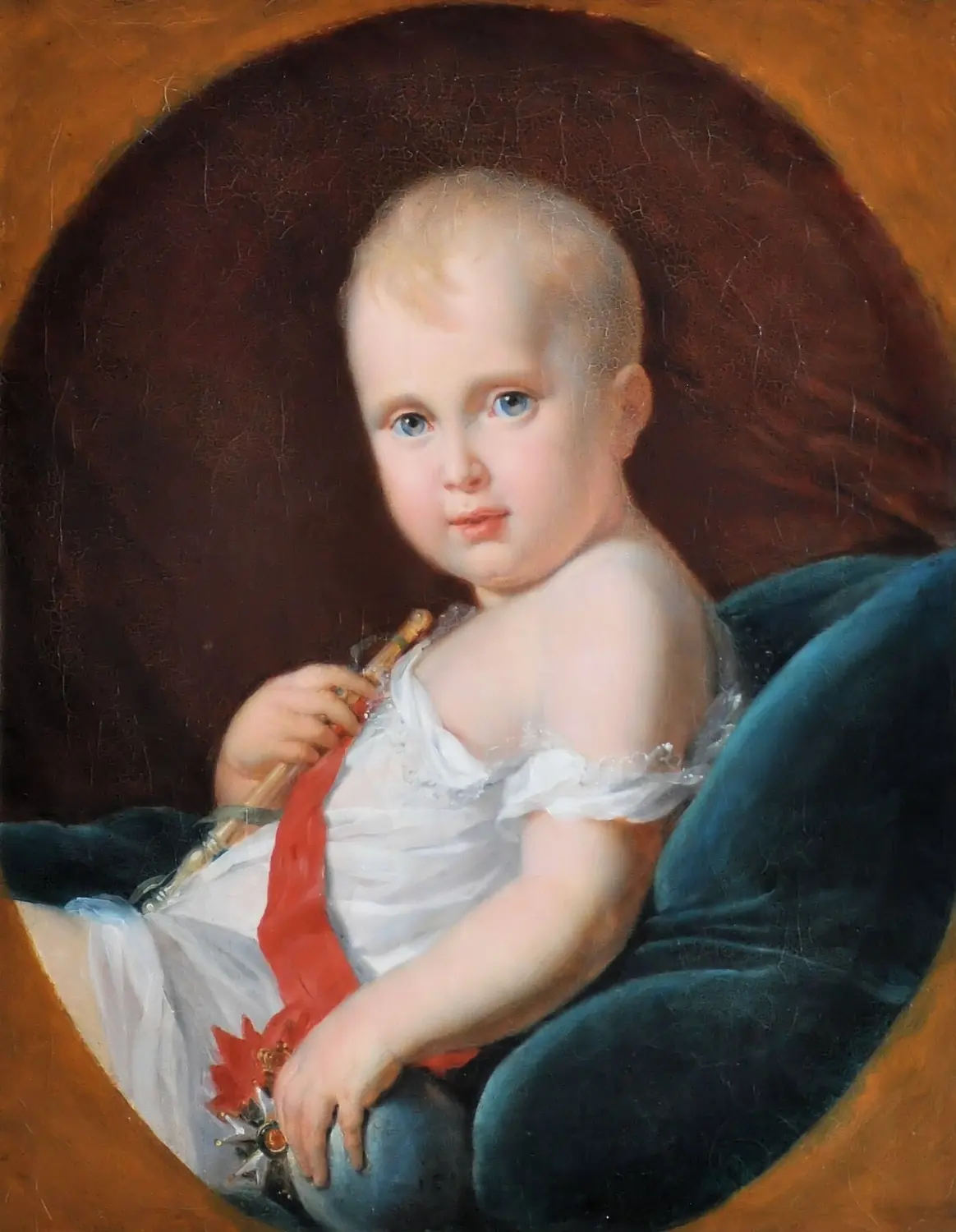
Public domain — Wikimedia Commons
1In brief
The son of Napoleon and Marie Louise, Napoléon François was born in 1811 and given the title King of Rome. Taken to Austria by his mother in 1814, he grew up there as the Duke of Reichstadt. When his father abdicated for the second time, in June 1815, he was proclaimed emperor, but he never reigned. He died of tuberculosis at Schönbrunn in 1832.
2Life
On 20 March 1811, a hundred and one cannon shots told the people of Paris that a boy had been born: Napoleon’s long-awaited heir had arrived at the Tuileries. He was given the title King of Rome. But he was only three when the Empire collapsed: his mother took him to Vienna, to the court of his grandfather, the Emperor of Austria. He never saw his father again.
On 22 June 1815, after Waterloo, Napoleon abdicated in favour of his son, whom his supporters proclaimed emperor as Napoleon II. But the child was in Vienna, and a few days later Louis XVIII returned to Paris. Brought up at Schönbrunn and made Duke of Reichstadt in 1818, the young man was passionate about the army and his father’s story. Suffering from tuberculosis, he died on 22 July 1832, aged twenty-one. In 1940 his coffin was moved from Vienna to the Invalides, near his father’s tomb.
3Role
- 1811Born at the Tuileries; King of Rome
- 1814Leaves for Vienna with his mother
- 1815Proclaimed emperor, without reigning
- 1818Duke of Reichstadt
- 1832Dies at Schönbrunn
4Legacy
His short life inspired poets: Victor Hugo wrote a poem about him, and Edmond Rostand’s play L’Aiglon (1900) made his nickname famous. It was by counting this reign without power that Louis Napoléon Bonaparte took the name Napoleon III in 1852.
5Did you know?
To announce his birth, twenty-one cannon shots were planned for a girl and a hundred and one for a boy: at the twenty-second shot, the crowd knew it was a boy.
The nickname “the Eaglet”, the young of the eagle, Napoleon’s emblem, was popularised by Edmond Rostand’s play.
 Napoleon I
 Marie Louise of Austria