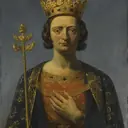
Philip IV
the Fair
The king who defied the pope, had the Templars arrested and governed with lawyers.
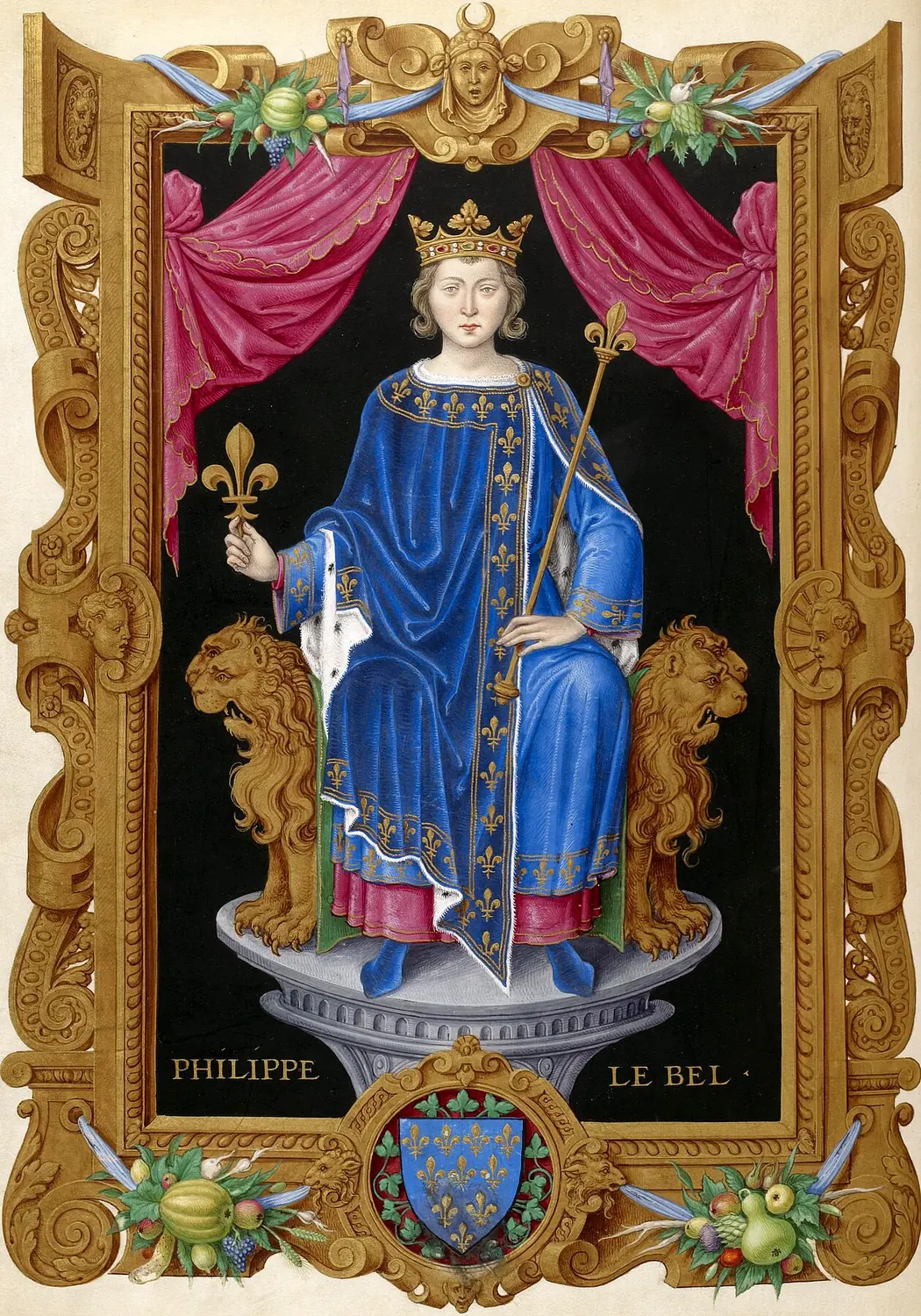
Public domain — Wikimedia Commons
1In brief
The son of Philip III, Philip the Fair reigned from 1285 to 1314. Surrounded by lawyers such as Guillaume de Nogaret, he strengthened the king’s authority over the pope, the great lords and the towns. He clashed with Pope Boniface VIII, had the Templars arrested in 1307 and raised new taxes. His reign is one of the most significant of the Middle Ages.
2Life
King at seventeen, Philip governed with advisers trained in Roman law, the legists, for whom the king was “emperor in his kingdom”. In conflict with Boniface VIII over taxing the clergy, in 1302 he gathered representatives of the clergy, the nobility and the towns: the first Estates General. In 1303 his men seized the pope at Anagni. Soon afterwards the papacy settled in Avignon.
Always short of money for his wars in Flanders and Guyenne, he debased the coinage, expelled the Jews in 1306 and seized their property, and on 13 October 1307 had all the Templars in France arrested. After a long trial their grand master, Jacques de Molay, was burned in 1314. That same year his sons’ wives were accused of adultery: the Tour de Nesle affair. He died at Fontainebleau in November 1314.
3Reign
- 1285King at seventeen
- 1302First Estates General; defeat at Courtrai
- 1303Attack on the pope at Anagni
- 1306Jews expelled from the kingdom
- 1307Arrest of the Templars
- 1314Death of Jacques de Molay; Tour de Nesle affair; death of the king
4Legacy
Philip the Fair gave the royal state lasting institutions and asserted the king’s independence from the pope. But his brutal methods and taxes left a dark image. His three sons succeeded him in turn, leaving no male heir.
5Did you know?
He was called “the Fair” because he was said to be very handsome. His other nickname, the “Iron King”, is modern: it comes from Maurice Druon’s 1955 novel, inspired by his cold, unbending character.
He was born and died at the château of Fontainebleau.
On the pyre, Jacques de Molay is said to have cursed the king and the pope to the thirteenth generation. The curse is a legend, made popular in the 20th century by the novels “The Accursed Kings”. But the pope and the king did both die within the year.
6Family
 Philip IIIFather
 Joan of NavarreWife
 Louis XChild
 Philip VChild
 Charles IVChild